America Can’t Stop Asking Google: “Is It Good or Bad?”
October 6, 2025
From wondering if eggs floating in the sink are still good, to whether melatonin is safe to take every night, Americans are turning to search engines for quick verdicts. A new analysis of 1,000+ U.S. search queries by Semrush reveals that the nation’s favorite search format is a simple, binary, “yes” or ”no” question: “Is it good?” or “Is it bad?”
The dataset paints a picture of a country outsourcing daily judgment calls to Google across health, food, tech, and even household myths.
Health & Wellness vs. Tech & AI
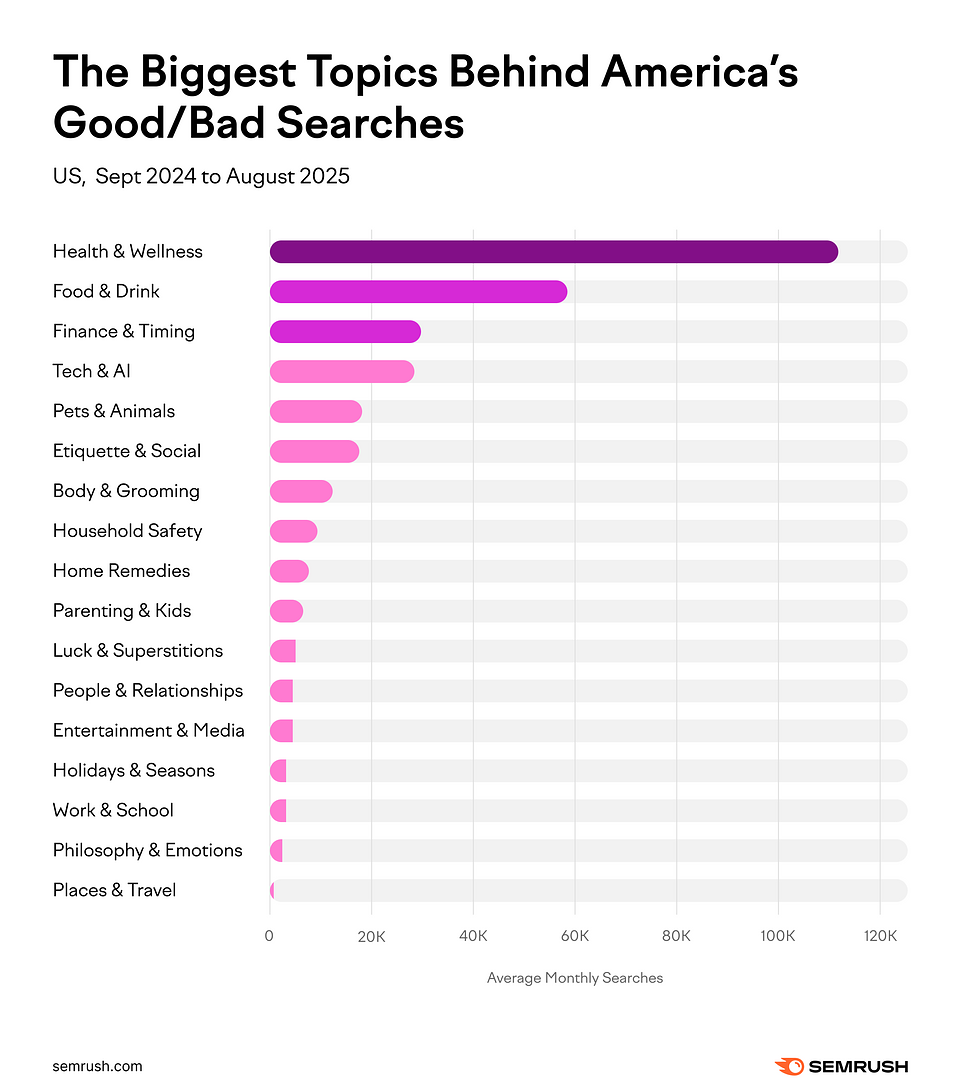
Health & Wellness is the strongest named category in the dataset, capturing more than 5% of total search volume. Queries often frame health decisions as a simple “yes” or “no” checks:
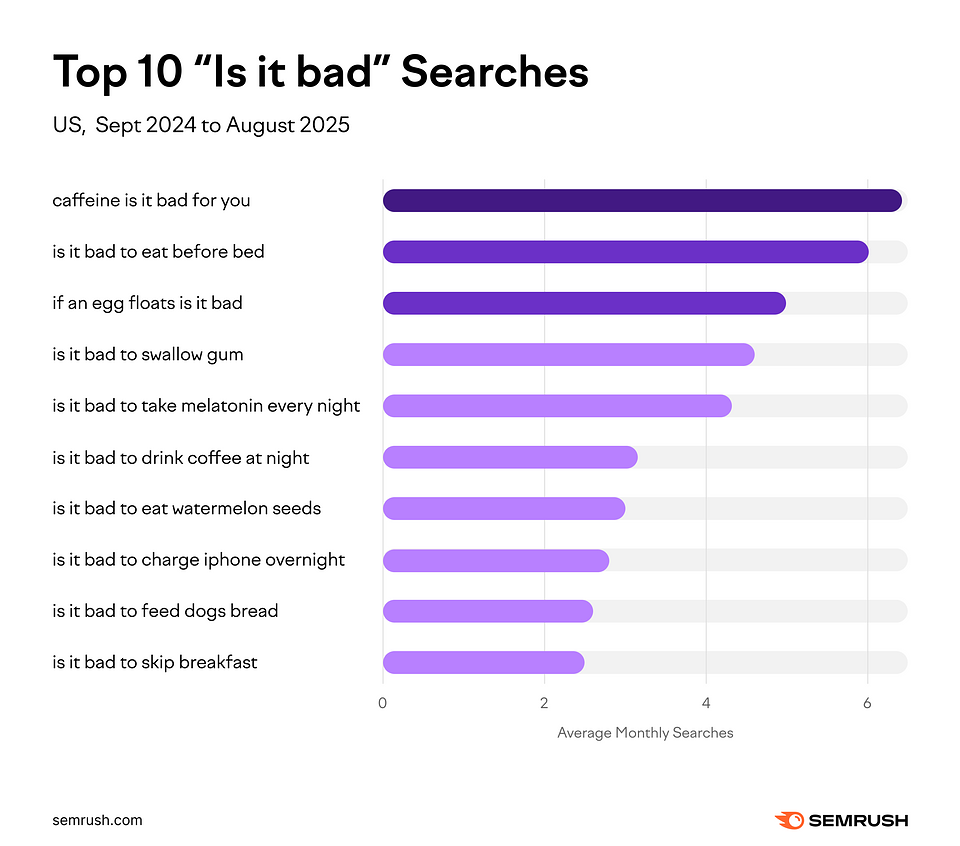
“caffeine is it bad for you” (6.4K average monthly searches)
“is it bad to take melatonin every night” (4.3K average monthly searches)
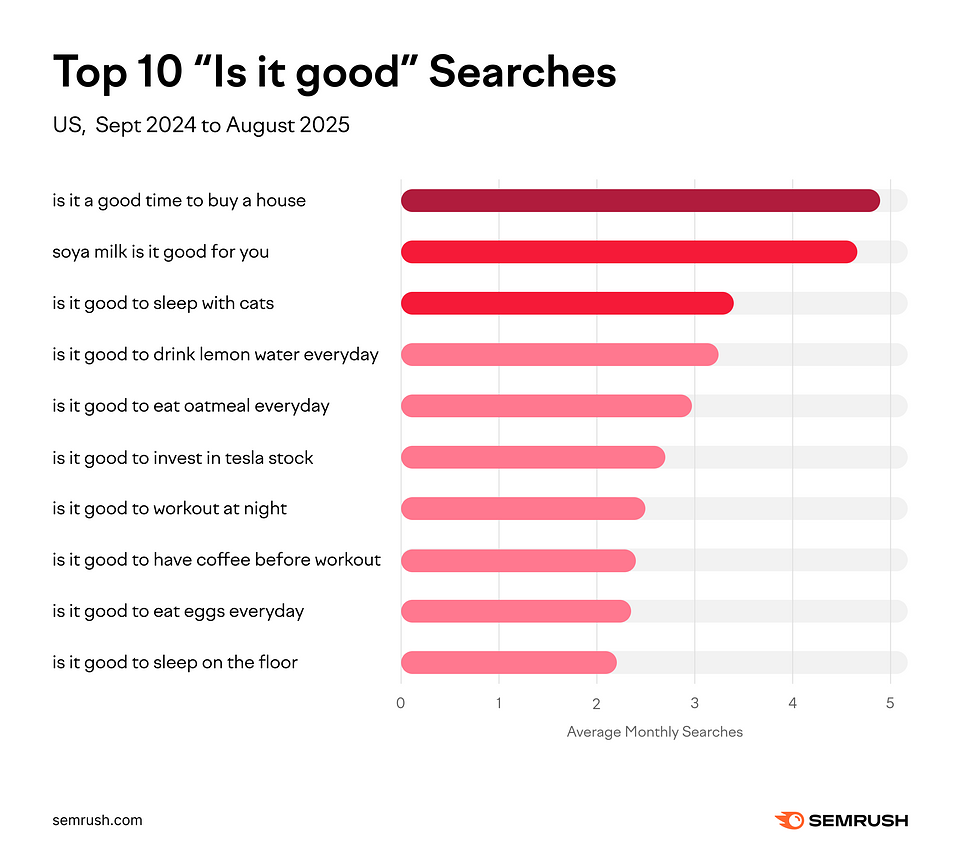
“soy milk is it good for you” (4.6K average monthly searches)
“is it bad to eat before bed” (6K average monthly searches)
By contrast, fewer queries touch on Tech & AI, but the goal remains the same: reassurance. People want to know whether AI or new platforms are safe, helpful, or risky.
Kitchen-Table Myths and Everyday Doubts
Not all searches are medical or digital – some belong in the kitchen or around the house. The internet is now the destination for quick rulings on habits passed down through folklore:
“if an egg floats is it bad” (4.9K average monthly searches)
“is it bad to swallow gum” (4.6K average monthly searches)
“is it bad to eat watermelon seeds” (3.2K average monthly searches)
“oatmeal is it good for weight loss” (2.2K average monthly searches)
“is it bad to eat eggs everyday” (2.3K average monthly searches)
“lemon juice is it good for you” (2.3K average monthly searches)
“eggplant is it good for you” (2K average monthly searches)
“is it bad to put hot food in the fridge” (1.6K average monthly searches)
These kinds of questions sit alongside other small daily worries, like whether it’s safe to feed dogs bread (2.6K average monthly searches) or whether it’s good to sleep with cats (3.4K). It’s a reminder that the most Googled anxieties are often the most ordinary.
General Questions vs. Brand Mentions
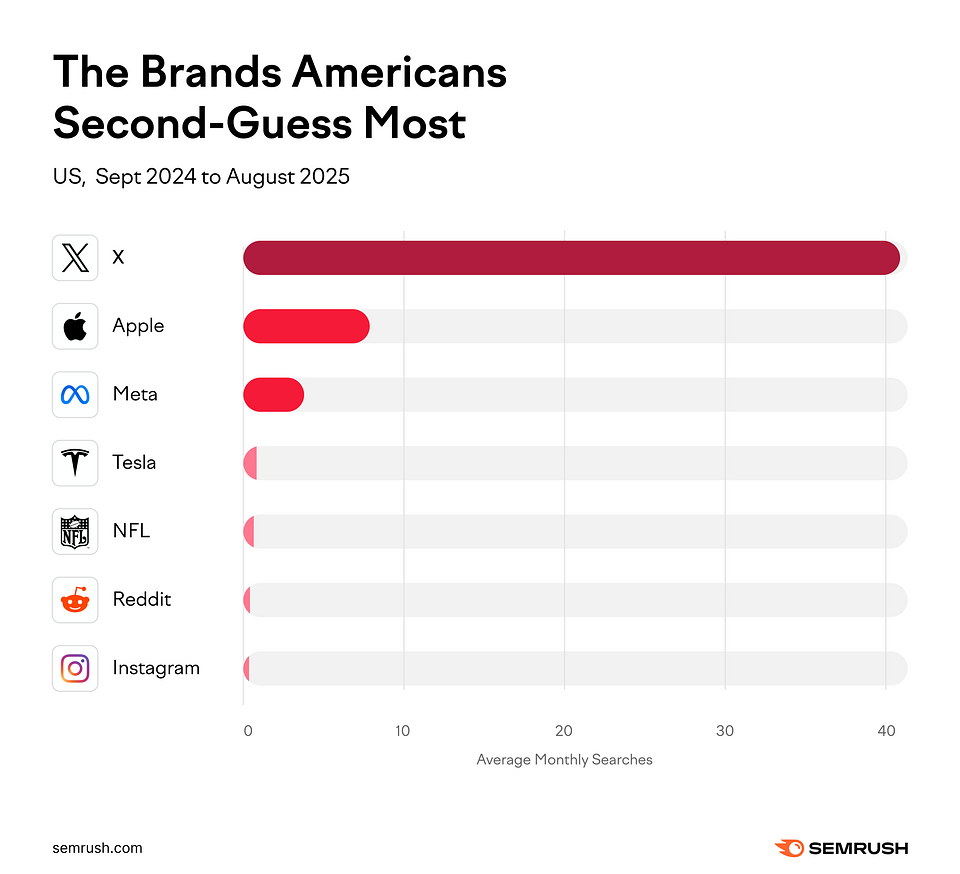
Well-known brands pop up often. X (formerly Twitter) with over 40K monthly searches, Apple (~7.8K), Meta, Tesla, Reddit, and Instagram among them. But in most cases, brands appear as the backdrop for a more general worry:
“is it bad to charge an iPhone overnight” (2.8K average monthly searches)
“is it good to buy Tesla stock now” (2.7K average monthly searches)
“is it bad to post on Instagram too much” (1.5K average monthly searches)
In other words, the intent is less about the brand itself and more about the user’s day-to-day behavior with it. These questions blur the line between broad categories like Tech & AI and brand-led concerns, but the underlying impulse is the same: seeking validation.
A Culture of Micro-Decisions
The study highlights a national pattern: Americans are turning to Google not only for facts, but to outsource judgment. Gone are the days when someone would pick up the phone to dial or text a trusted friend for their input.Instead, the U.S. is opting for self-service information from the internet.
Why This Matters in the AI Search Era
Most of these verdict-style questions – “is it bad to swallow gum,” “is it good to buy Tesla stock,” “is it bad to charge an iPhone overnight” – are exactly the kinds of prompts that Google’s AI Overviews and generative engines like ChatGPT or Perplexity now prioritize.
Instead of scanning multiple blue links, users increasingly get one AI-generated summary that attempts to give a final “yes/no” or “it depends” verdict. That makes these queries even more critical for brands and publishers:
Answer ownership: If your content isn’t cited in an AI Overview, someone else’s will be.
Authority signaling: AI systems favor sources with trust signals (authority, clarity, structured content).
Category risk: Everyday lifestyle, health, and tech questions – the very ones driving this dataset – are among the most AI-disrupted search types.
Bottom line: In an AI-first search world, verdict-style questions are no longer just traffic opportunities; they’re brand visibility risks if you don’t appear in the generated answers.
To win visibility in this new landscape, brands need to be strong in AI search and classic SEO at the same time. Semrush brings both together:
How Semrush Helps
AI Visibility:
AI Overview Tracking → see where your brand (or competitors) appears in Google’s AI Overviews.
AI SEO →Track mentions across ChatGPT, Perplexity, Claude, and more.
SEO Foundation
Keyword Magic Tool → find the “is it good / is it bad” questions in your category.
Keyword Gap Tool → discover where competitors rank and how you can close the gap.
In short: Semrush helps marketers not just understand what people ask, but make sure their brand is the one providing the answer whether in a classic search result or in AI-generated summaries.
Semrush Study: Super Bowl Ads Are No Longer a One-Night Event
What social engagement, search behavior, and AI-generated answers reveal about who really won the up-to-$10M ad battle
Data & Insights
February 13, 2026
The Brand Visibility Mandate: Why SEO Must Evolve for the AI Discovery Era
The rules of digital visibility are changing fast. As generative AI engines increasingly shape how people discover, evaluate, and choose brands, traditional SEO metrics alone no longer tell the full story. Rankings still matter, but they are no longer the only gateway to...
Data & Insights
January 27, 2026
Holiday Shopping 2025: What Traffic Data Reveals About Search, AI, and How People Actually Buy
The 2025 holiday shopping season followed a familiar rhythm: early research, a compressed deal frenzy, a deadline-driven December, and then a quiet post-holiday reset. But beneath that familiar shape, Semrush traffic data from 19 of the world’s largest retailers reveals ...